A Self-Serve Beam AI (iBeam.ai) Alternative for HVAC Takeoff
Beam AI — the construction takeoff product on iBeam.ai — markets DIY takeoffs in about ten minutes with roughly 90% feature capture, plus a done-for-you option where a team returns a QA-reviewed takeoff in 24–72 hours. It is a capable, fast-growing tool, and this is a fair comparison, not a takedown. If you want someone else to run your takeoff and hand it back, that done-for-you model is genuinely useful.
DuctIQ takes a different stance for HVAC: self-serve AI ductwork takeoff you run yourself in minutes, where every quantity is a reviewable line item you stay in control of. Below is a side-by-side of the workflow, a direct answer to the "ten minutes / 90% capture" framing, a published-pricing and ROI comparison, and a note clearing up the Beam AI domain confusion.
Start your free takeoffSee pricing
No credit card — your first takeoff is free. Want proof first? Download a real sample takeoff — no signup.
iBeam vs beam.ai: clearing up the name
Quick clarification first, because the name trips people up and the two are easy to conflate in a search. The Beam AI construction and HVAC takeoff product lives on the iBeam.ai domain — that is the one worth comparing against for HVAC work. A separate site, beam.ai, is an unrelated enterprise AI-agents and automation platform: a different company in a different category, not construction takeoff software. So if you searched "Beam AI" and landed on an AI-agents page, that is beam.ai, not the takeoff tool.
Throughout this page, "Beam AI" and "iBeam" both mean the iBeam.ai construction takeoff product. If you are evaluating that tool for HVAC ductwork, the comparison below is for you.
When Beam AI makes sense
Beam AI makes sense if you want a takeoff taken off your plate. The done-for-you service — hand over drawings, get back a QA-reviewed takeoff in a day or two — suits a shop that is slammed, lacks an in-house estimator, or wants an extra pair of hands at peak bid season. It also reaches across construction trades beyond mechanical, so if your takeoff needs are broad, that breadth has value.
If your bottleneck is capacity rather than control, paying for a delivered takeoff is a legitimate, sensible choice — and we would rather you solve the real bottleneck than switch for switching's sake.
When DuctIQ makes sense
DuctIQ makes sense when you want to own the takeoff and the turnaround. Instead of waiting 24–72 hours for a delivered result, you upload the mechanical PDF and get a reviewable HVAC ductwork takeoff in minutes, any time of day, without a hand-off. It is built specifically for mechanical work, so the output is already organised the way an estimator bids.
- You want the takeoff now, self-serve, not delivered in a day or two.
- You want every duct run, fitting, and device as a reviewable line item you can verify.
- You want supply, return, and exhaust separated and grouped by size automatically.
- You want equipment and air devices pulled from the schedules, plus SMACNA-aware shop drawings for the shop.
- You want a clean Excel/CSV export that drops straight into your bid sheet — no re-keying, no proprietary lock-in.
Workflow comparison
Both get you from a drawing to priced quantities; the difference is how much you control and how fast you get there.
| Step | DIY tool or done-for-you service | DuctIQ |
|---|---|---|
| Upload | Upload to a DIY tool, or send drawings to a delivery team | Upload the mechanical PDF yourself — single sheet or full set |
| Detect ductwork | AI captures features; a delivered takeoff may take 24–72 hours | AI auto-detects duct, fittings, equipment, and devices in minutes, self-serve |
| Review | Rely on a stated capture figure, or wait for a QA pass | Every line shown with a status; low-confidence reads flagged for you to confirm |
| Excel export | Export or receive an Excel/CSV file | Structured Excel/CSV — system, size, gauge, qty — straight into your bid sheet |
| Audit trail | Depends on the deliverable | Each line traces back to its source sheet, so you can defend any number |
A fair, workflow-level comparison. iBeam.ai's Beam AI is a capable tool with a useful done-for-you option; the contrast is self-serve control and HVAC specificity.
The review workflow: instant and self-serve, not a 24 to 72 hour QA pass
Beam AI's done-for-you tier answers the "is it human-reviewed?" question by having a team review your takeoff and hand it back in a day or two. DuctIQ answers it differently: the review is built into the tool and happens the moment the takeoff finishes, so you are the QA and you are not waiting on a queue.
Every duct run, fitting, and device comes back as a line with a Review Status, and the runs the AI was less sure about are flagged for you rather than buried. You work those first, confirm the rest, and export — in minutes, not next day.
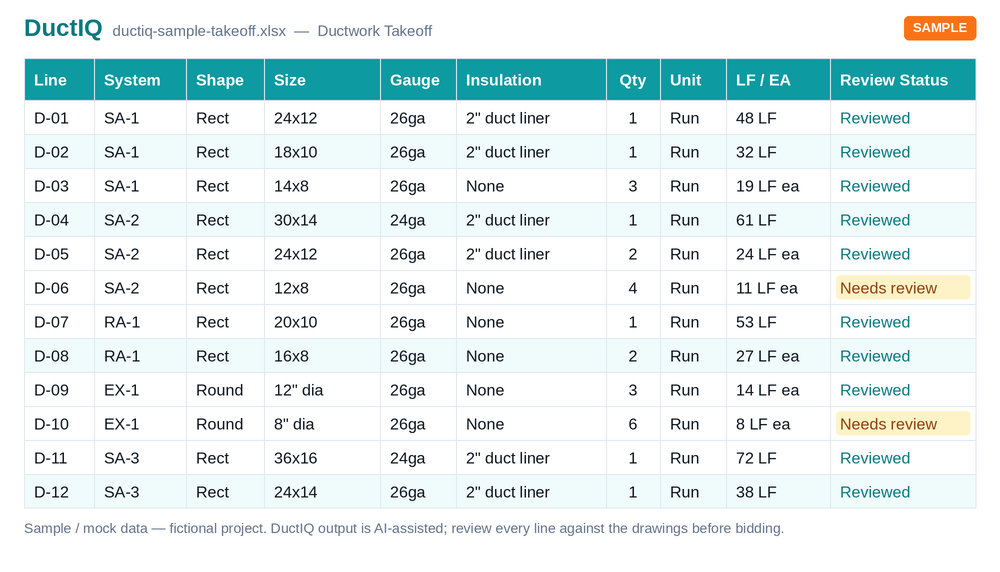
- Review Status on every line: "Reviewed" or "Needs review", visible at a glance.
- Low-confidence runs flagged with a reason (no readable scale, missing size callout), so you know why to look.
- Each line traces to its source sheet — the same audit trail a delivered QA pass gives you, available instantly.
- A review queue groups the uncertain lines so you check them first.
- You confirm before anything exports; the takeoff is never a trust-me total.
Pricing, side by side
Beam AI publishes its pricing, which makes an honest comparison possible. As of mid-2026, iBeam.ai lists its DIY AI takeoff at roughly $8,000 per year per trade, and its done-for-you service at roughly $15,000 to $25,000 per year per trade. Those are annual, per-trade licences — verify the current figures on iBeam.ai, since SaaS pricing moves.
DuctIQ is priced on a different model entirely: transparent monthly plans from $29.99 up to $99.99 per month for high-volume teams, with no per-trade licence and no annual lock-in — cancel anytime, and pay-as-you-go credit top-ups never expire. For a single mechanical contractor that works out to roughly $360 to $1,200 a year against an $8,000-plus annual licence — close to an order of magnitude apart.
| Beam AI (iBeam.ai), published | DuctIQ | |
|---|---|---|
| DIY / self-serve AI | ~$8,000 / year per trade | $29.99–$99.99 / month (~$360–$1,200 / year) |
| Done-for-you | ~$15,000–$25,000 / year per trade | Self-serve by design — you run and own the takeoff |
| Commitment | Annual licence, per trade | Monthly, cancel anytime; non-expiring credit top-ups |
| Export | Excel/CSV deliverable | Excel/CSV you generate yourself — no proprietary lock-in |
Competitor figures are iBeam.ai's publicly listed pricing as of mid-2026 and may change — verify on their site. DuctIQ pricing is always current on our pricing page.
Does it pay for itself? A quick ROI check
The honest test for takeoff software is hours saved against what it costs. A manual HVAC ductwork takeoff on a mid-size commercial set runs several hours; DuctIQ returns a reviewable first pass in minutes, so estimators typically save on the order of three to six hours per takeoff — time that goes straight back into bidding more work or tightening the numbers.
Put a loaded estimator cost of about $60 an hour against that. Saving even two hours a week is roughly $480 a month of recovered time — already several times a DuctIQ plan. Run a few takeoffs a week and the plan pays for itself on the first job of the month, with the rest of the month's savings clear.
| Hours saved / week | Recovered time / month (≈$60/hr loaded) | DuctIQ plan | Net after the plan |
|---|---|---|---|
| 2 hours | ~$480 | from $29.99 / mo | ~$450+ ahead |
| 5 hours | ~$1,200 | from $29.99 / mo | ~$1,150+ ahead |
| 10 hours | ~$2,400 | $99.99 / mo (high-volume) | ~$2,300+ ahead |
Illustrative — swap in your own hourly figure. The conclusion holds across any realistic estimator rate: the plan pays back within the first takeoff of the month.
"Ten minutes / 90% capture" — what DuctIQ does instead
A single capture-accuracy percentage is a marketing number; what an estimator actually needs is to know which lines to trust. DuctIQ does not ask you to take a blanket percentage on faith. It returns every duct run, fitting, device, and piece of equipment as a line item, and it flags the ones it is not confident about so you check those rather than the whole set.
On speed, DuctIQ is in the same minutes-not-hours range — most mechanical sets process in minutes, many well under ten — but the goal is time to a takeoff you trust, review included, not a stopwatch headline. You get the fast first pass and the line-level visibility to stand behind the bid, without waiting on a delivery window.
Download a sample takeoff (Excel)How DuctIQ measures ductwork
The HVAC-specific difference
General construction takeoff — DIY or delivered — measures whatever is in front of it. DuctIQ is built only for HVAC mechanical work, so it understands the difference between a supply trunk and a return, a reducer and a tee, and reads the equipment and air-device schedules. The takeoff comes back grouped by system and size, with fittings, devices, and equipment in their own buckets, and carries through to fabrication-ready shop drawings with SMACNA-aware gauge, material, and seam callouts. That depth on ductwork is what a general tool is not built to produce.
A pre-bid QA checklist (beyond the capture percentage)
Beam AI markets about 90% feature capture and '±1% of in-house accuracy.' Those are averages, not a verdict on your drawing — and a number you cannot see line by line is not a number you can defend to a GC. DuctIQ's answer is a takeoff where the QA is visible and yours: every quantity reviewable, SMACNA-aware output for the shop, and an export in the format your estimating workflow needs. Use this five-step review on any takeoff — DuctIQ's, or a done-for-you one — before it goes into a bid:
- Scale — confirm the read scale against the title block; one known dimension is enough to catch a 1:50 vs 1:100 mix-up.
- Every flag — clear each 'Needs review' line rather than trusting a blanket capture figure.
- System LF — check the largest trunks and total linear feet per system against your sense of the job.
- Equipment counts — reconcile against the schedules, especially tags repeated across floors.
- Gauge to spec — verify against the project specification; DuctIQ's SMACNA-minimum fallback is labelled, not hidden.
Download a reviewable sample takeoff (Excel)
Run your first takeoff free
Upload a mechanical PDF and get a reviewable ductwork, fittings, and equipment takeoff you can export to Excel. No credit card to try your first drawing.
Start your free takeoff Download a sample takeoff See pricingNew to AI takeoff and want a hand? Send us your first drawing and we'll help you review the output, or book a 1:1 walkthrough.
Related HVAC takeoff guides
Frequently asked questions
Is Beam AI the same as beam.ai?
No — and it is a common mix-up. The construction takeoff product branded Beam AI lives on iBeam.ai. The domain beam.ai is a separate enterprise AI-agent automation platform for finance and HR operations, unrelated to construction takeoff. This page compares DuctIQ with the iBeam.ai construction product.
Is DuctIQ a replacement for Beam AI's done-for-you takeoffs?
For HVAC ductwork, DuctIQ replaces the wait with a self-serve takeoff you run yourself in minutes and review line by line. If you specifically want a takeoff fully delivered for you, that is a different model — DuctIQ keeps you in control rather than handing the work off.
How does DuctIQ answer the "10 minutes, 90% capture" claim?
DuctIQ processes most mechanical sets in minutes too, but instead of a single capture percentage it shows every line with a status and flags low-confidence reads, so you verify the uncertain items rather than trusting a blanket number. The metric that matters is time to a takeoff you can bid, review included.
What does DuctIQ export?
The full HVAC takeoff — duct by system and size, fittings, air devices, and equipment — exports to Excel (.xlsx) or CSV with structured columns, so it drops into your pricing workbook without re-keying and nothing is locked in a proprietary format.
How does DuctIQ's pricing compare to Beam AI's?
Beam AI (iBeam.ai) publicly lists roughly $8,000 per year per trade for its DIY AI takeoff and about $15,000 to $25,000 per year per trade for its done-for-you service — verify current figures on their site. DuctIQ runs on transparent monthly plans from $29.99 to $99.99 per month with no per-trade licence and no annual lock-in, which for most single contractors is close to an order of magnitude less per year.
How do I try DuctIQ without committing?
Download a real sample takeoff with no account, then run a free first takeoff by uploading a mechanical drawing and reviewing the result before choosing a plan.