HVAC Estimating Software for Contractors: AI Takeoff to Excel
Try AI Takeoff Free
No credit card · Upload a PDF in 10 seconds · Runs in your browser on Mac or Windows
Try AI Takeoff FreeSee an AI Takeoff in 10 Seconds
The sample is a real DuctIQ takeoff workbook: no signup. Plans and credits are on the pricing page.
Every HVAC estimate is built on two things: the quantities and the prices you put against them. DuctIQ is the quantities half — HVAC estimating software that reads your mechanical PDF drawings and returns a reviewable ductwork, fittings, and equipment takeoff you can price in whatever workbook or estimating system you already trust.
We call it takeoff-first for a reason. Get the duct measured accurately and organised the way you bid, and the pricing step is fast and defensible. Skip or rush the takeoff and no amount of unit-price polish saves the number. Below is the actual deliverable an estimate starts from — downloadable before you sign up for anything.
The sheet your estimate starts from
This is the real file the engine hands to pricing — the same structured export the pipeline produces, with the review flags an estimator clears before a single unit cost is applied:
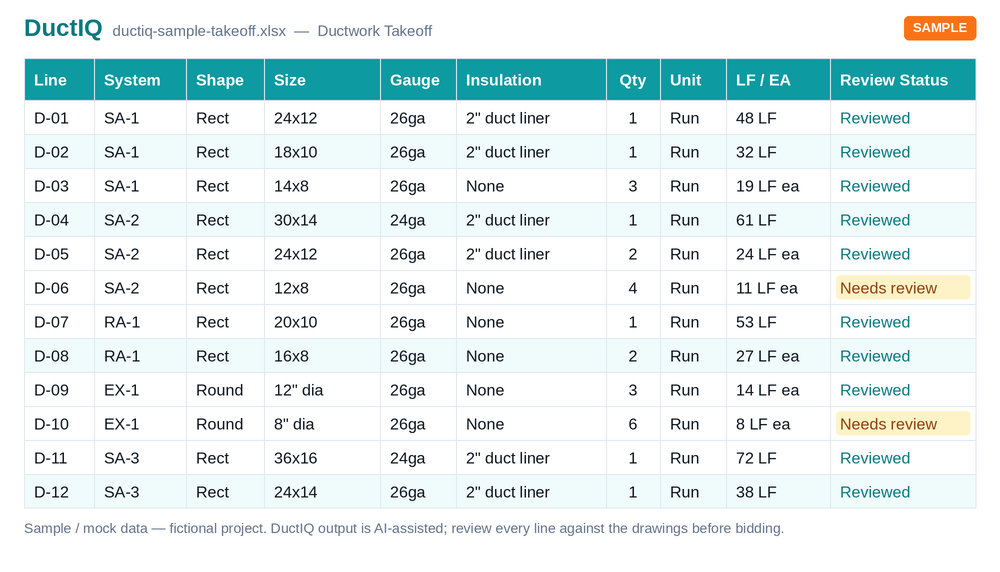
- Component coverage: supply/return/exhaust duct by size, typed fittings (elbows, tees/taps, reducers/transitions), RTUs, VAV boxes, diffusers and grilles from the schedules, SMACNA-aware gauge and sheet-metal pounds.
- Review controls before pricing: every line carries a Review Status, low-confidence reads are flagged with the reason and queued first, and each line traces to its source sheet — you confirm before anything reaches the estimate.
- Export proof: one click to Excel (.xlsx) or CSV with bid-ready columns and separate Fittings and Equipment tabs; your formulas and unit costs attach directly.
Download the sample takeoff (Excel)Download the CSV version
Quantities first, pricing second
Most tools sold as HVAC estimating software lead with rate tables and assembly libraries, then leave the takeoff — the part that actually decides whether the bid is right — as manual clicking. DuctIQ inverts that. The drawing goes in, and supply, return, and exhaust ductwork comes back measured in linear feet by size and system, with fittings counted and equipment lifted from the schedules.
That ordering matters on a deadline. An estimator who starts with trustworthy quantities can spend the remaining hours on pricing strategy and scope, not on scaling ducts by hand or second-guessing a rushed count.
- Ductwork measured by size and system, in linear feet.
- Fittings identified and counted, not estimated as a percentage.
- Equipment pulled from the drawing's schedules with tags.
- Every line reviewable before it reaches your price.
- Excel and CSV export into the pricing workbook you already use.
Start your free takeoffOr download a real sample takeoff first
It plugs into your bid workflow — it isn't a new one
DuctIQ is not trying to replace your estimating system, your spreadsheet, or the way your shop prices work. It produces the structured mechanical takeoff and exports it, so it sits in front of whatever you bid with today. If you price in Excel, the quantities land in Excel. If you run a dedicated estimating package, the export feeds it.
That keeps the change small and the risk low: you adopt a faster, more consistent takeoff without re-platforming how you quote.
You don't need a BIM model to get fast quantities
A growing slice of the market is pushing HVAC contractors toward BIM coordination and managed model-based delivery. That has its place on coordinated, model-driven projects — but most bids don't need a federated model or a BIM services layer to produce a number. They need accurate quantities from the drawings on the deadline in front of them.
DuctIQ is deliberately the mechanical-only specialist for that job. It reads 2D mechanical PDFs and returns priceable duct, fittings, and equipment — no model authoring, no coordination service, no new delivery process to buy into. When a project genuinely needs BIM, you still run BIM; when you just need to bid the work, you don't have to.
Mechanical scope, read in mechanical terms
General construction estimating tools treat a mechanical plan like any other floor plan and leave the estimator to supply the trade knowledge. DuctIQ is built specifically for HVAC and sheet metal work, so the takeoff comes back already organised the way mechanical contractors bid — duct by system and size, fittings by type, equipment by tag.
That specialisation is why the output is reviewable rather than raw: it speaks the units an estimator checks against the drawing, not generic areas and counts that still need interpreting.
Where to go next
If you want to see exactly how the quantities are produced, the ductwork takeoff and AI takeoff pages walk through the measurement and review step by step. If you're comparing against a tool you already pay for, the PlanSwift and Bluebeam alternative pages lay out where an HVAC-specific workflow differs from a manual, general-purpose one.
Whichever way you come in, the deliverable is the same: a reviewable mechanical takeoff that exports straight into your estimate.
Weighing an outsourced takeoff service instead?The export, column by column
Run your first takeoff free
Upload a mechanical PDF and get a reviewable ductwork, fittings, and equipment takeoff you can export to Excel. No credit card to try your first drawing.
Start your free takeoff Download a sample takeoff See pricingNew to AI takeoff and want a hand? Send us your first drawing and we'll help you review the output, or book a 1:1 walkthrough.
Related HVAC takeoff guides
Frequently asked questions
What is HVAC estimating software?
It's software that helps mechanical contractors turn HVAC drawings into a priced bid. DuctIQ focuses on the takeoff half — reading the drawings and producing reviewable ductwork, fittings, and equipment quantities — then exports to Excel/CSV so they feed whatever you price with.
Is DuctIQ a full estimating suite or a takeoff tool?
DuctIQ is takeoff-first: it produces the structured mechanical quantities and exports them, rather than replacing your pricing workbook or estimating system. It plugs into the bid workflow you already use.
What's the difference between HVAC estimating software and ductwork estimating software?
They overlap heavily — ductwork estimating software is the duct-focused core of an HVAC estimate. DuctIQ measures ductwork by size and system and also pulls fittings and equipment, so the duct takeoff arrives alongside the rest of the mechanical scope.
Do I need BIM or a BIM service to estimate HVAC?
No. BIM coordination matters on model-driven projects, but most bids only need accurate quantities from the drawings. DuctIQ reads 2D mechanical PDFs and returns priceable duct, fittings, and equipment with no model authoring or managed BIM layer required.
Does it work as mechanical estimating software for commercial bids?
Yes. It handles multi-page commercial mechanical sets — supply, return, and exhaust ductwork plus fittings and scheduled equipment — and produces a reviewable takeoff you can price for the bid.
How do the quantities get into my estimate?
The full takeoff exports to Excel and CSV, so the reviewed quantities drop straight into your pricing workbook or estimating system without re-keying.