HVAC Takeoff Service vs Software: Which Should You Pay For?
There are two established ways to get a mechanical takeoff done without doing it all by hand: pay a takeoff service to deliver the quantities for you, or buy takeoff software and produce them in-house. Both are legitimate. Services sell turnaround without staffing; software sells control without per-project fees. Several vendors now sell both — Beam AI (iBeam.ai) and Kreo, for example, offer done-for-you delivery alongside their tools — which is exactly why buyers end up searching this comparison.
This page lays out the honest trade-offs — cost structure, turnaround, control, and accountability — and then the part that changes the decision: AI takeoff software now does the measuring itself, which used to be the whole reason to outsource. DuctIQ is that third shape for HVAC ductwork: upload the mechanical PDF, review the takeoff line by line, export to Excel — service-level effort savings, software-level control.
Start your free takeoffSee pricing
No credit card — your first takeoff is free. Want proof first? Download a real sample takeoff — no signup.
How an outsourced takeoff service works
You send the drawing set to a provider — an independent estimating firm or a software vendor's delivery arm — and their estimators produce the takeoff, usually returned as an Excel workbook or a marked-up set within one to three business days. Pricing is typically per project, per sheet, or hourly, scaled to the set's size and complexity; done-for-you tiers from software vendors run as annual contracts (Beam AI, for instance, publishes roughly $15,000–$25,000 per year per trade for its delivered service — verify current figures with any provider, since pricing moves).
The appeal is real: no software to learn, no estimator hours consumed, and an experienced second pair of eyes on the set. For a shop with no in-house estimator, or one buried at peak bid season, outsourcing is often the difference between bidding a job and passing on it.
How takeoff software works
Software keeps the takeoff in-house. Traditional on-screen tools (PlanSwift, Bluebeam and similar) give your estimator faster measuring and counting on the PDF; the estimator still drives every measurement. You pay a licence — commonly a few hundred to a couple of thousand dollars per seat per year — and the marginal cost of each additional takeoff is your estimator's time, not a service invoice.
The appeal is the mirror image of the service: full control of assumptions and quality, instant start (no queue), the takeoff knowledge stays in your shop, and heavy bidders amortise the licence across every job.
The honest trade-off, side by side
Neither option dominates. The columns below are the questions that actually decide it — and they are worth asking any provider or vendor directly.
| Decision factor | Outsourced takeoff service | Traditional takeoff software |
|---|---|---|
| Cost shape | Per project / per sheet / annual delivery contract — scales with every bid | Licence per seat — flat, amortises with volume |
| Turnaround | Typically 1–3 business days, queue-dependent | Starts instantly; limited by your estimator's hours |
| Who controls assumptions | The provider's estimator; you review the deliverable after the fact | Your estimator, at every step |
| Accountability at bid time | You defend numbers someone else produced | You defend numbers you produced |
| Staffing needed | None — that is the point | A trained estimator with tool time |
| Knowledge retention | Stays with the provider | Compounds in your shop |
Category-level comparison. Specific turnarounds, prices, and review processes vary by provider — confirm them directly before committing a bid deadline to either.
When outsourcing is the right call
Be honest about capacity before optimising for control. Outsourcing wins when you have no estimator and no plans to hire one; when bid season stacks deadlines your team physically cannot meet; or when a one-off project sits outside your usual trade and an experienced outside estimator de-risks it. In those cases a delivered takeoff is not a compromise — it is the only version of the bid that happens at all.
The costs to go in eyes-open on are the structural ones: every future bid carries the fee, rush deadlines depend on someone else's queue, and each delivered takeoff still needs your review before you price it — outsourcing the measuring never outsources the responsibility for the number.
What AI takeoff software changes
The classic case for a service was never really about turnaround — it was that measuring is the time sink, and a service moves that sink out of your shop. AI takeoff software moves it out of human hands entirely. DuctIQ reads the mechanical PDF and performs the HVAC ductwork takeoff itself: duct runs measured at scale and grouped by system and size, fittings counted, equipment and air devices pulled from the schedules.
That collapses the trade-off table. The effort profile looks like a service — you review a produced takeoff rather than building one — but the control profile stays software: it happens in minutes instead of days, there is no queue, every line item is yours to audit with low-confidence reads flagged first, and the result exports to structured Excel/CSV for the workbook you already price in.
- Turnaround: minutes, self-serve, any time — no delivery window on the critical path of a bid.
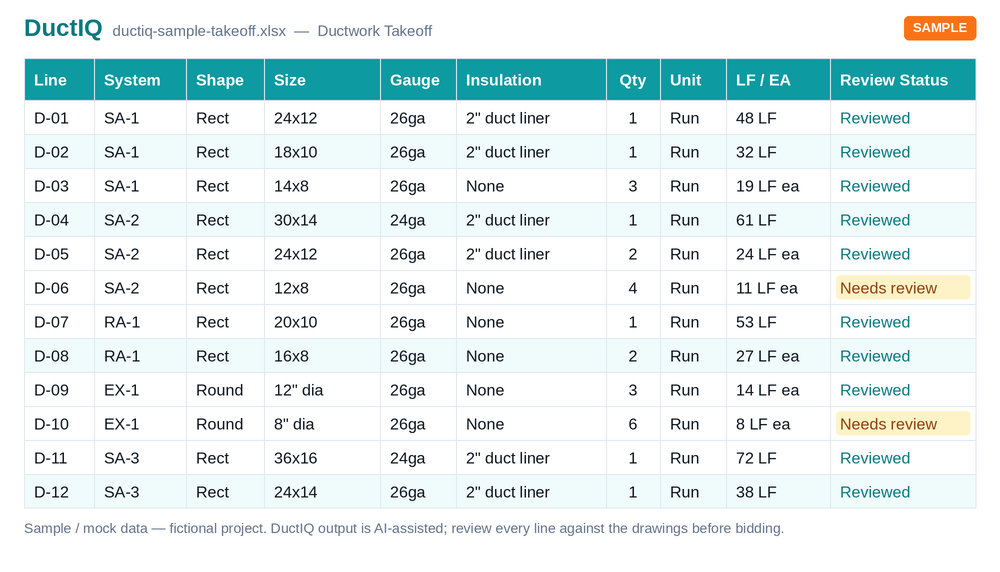
- Control: every duct run, fitting, and device is a reviewable line with a status; you confirm before anything exports.
- Cost shape: monthly plans from $29.99 with non-expiring credit top-ups — closer to a licence than a per-project fee, at a fraction of a delivery contract.
- Accountability: line-to-sheet traceability, so the number you defend is one you audited.
A quick cost sanity check
Run your own numbers rather than trusting anyone's marketing, ours included. Count the mechanical bids you produced last quarter, price them at a service's per-project fee (or a delivery contract's annual figure divided by your bid count), and compare that against a software licence plus the estimator hours each takeoff still consumes. For most shops bidding even a few mechanical jobs a month, per-project fees overtake a subscription within the first handful of bids — and if the software also does the measuring, the estimator-hours column shrinks too.
The sample below is the actual DuctIQ deliverable, downloadable without an account, so you can judge the output quality against what a service returns before spending anything.
Download a sample takeoff (Excel)See DuctIQ pricing
The hybrid answer most shops land on
This is not a purity contest, and the pragmatic answer is often both. Keep a service relationship for overflow weeks and out-of-trade projects; run your bread-and-butter mechanical bids through software you control. Because DuctIQ exports standard Excel and CSV, it slots into that mix without lock-in — a DuctIQ takeoff, a delivered takeoff, and a hand-measured one can all land in the same pricing workbook.
The practical way to decide is a head-to-head on one real bid: send the set to your service, run the same PDF through DuctIQ (the first takeoff is free), and compare quantities, turnaround, and how each result stands up to your own review.
Start your free takeoffHow the Excel export is structured
Run your first takeoff free
Upload a mechanical PDF and get a reviewable ductwork, fittings, and equipment takeoff you can export to Excel. No credit card to try your first drawing.
Start your free takeoff Download a sample takeoff See pricingNew to AI takeoff and want a hand? Send us your first drawing and we'll help you review the output, or book a 1:1 walkthrough.
Related HVAC takeoff guides
Frequently asked questions
Is it better to outsource an HVAC takeoff or use software?
It depends on capacity and volume. Outsourcing wins with no in-house estimator or during deadline crunches; software wins on cost per bid, turnaround, and control once you bid regularly. AI takeoff software narrows the gap from the software side — DuctIQ produces the ductwork takeoff for you in minutes, so the effort argument for outsourcing largely disappears while control stays in-house.
How much does an outsourced HVAC takeoff cost?
Independent services typically price per project, per sheet, or hourly, scaling with the drawing set; software vendors' done-for-you tiers run as annual contracts — Beam AI, for example, publishes roughly $15,000–$25,000 per year per trade for delivered takeoffs. Always confirm current pricing with the provider. DuctIQ, by contrast, runs $29.99–$99.99 per month with a free first takeoff.
How fast is a takeoff service versus software?
Delivered takeoffs commonly quote one to three business days, subject to the provider's queue and rush fees. Traditional software starts instantly but consumes estimator hours per takeoff. DuctIQ processes most mechanical sets in minutes and needs only your review pass, so it is the fastest path to a number you can defend.
Do I still have to review an outsourced takeoff?
Yes — outsourcing the measuring never outsources responsibility for the bid. A delivered takeoff should get the same scrutiny as an in-house one: scale checks, system totals, equipment counts against the schedules. DuctIQ builds that review in, with every line carrying a status and low-confidence reads flagged for you first.
Can I use a takeoff service and DuctIQ together?
Yes, and many shops should: a service for overflow and out-of-trade work, DuctIQ for regular mechanical bids. Everything exports to standard Excel/CSV, so both feed the same pricing workbook with no lock-in either direction.
How do I compare the two on a real project?
Run one bid both ways: send the set to a service and upload the same mechanical PDF to DuctIQ — the first takeoff is free, and a sample export is downloadable without an account. Compare quantities, turnaround, cost, and how well each result survives your own line-by-line review.