A Handoff AI (H1) Alternative for HVAC and Ductwork Takeoff
Handoff announced H1 on July 21, 2026, positioning it as the first AI model for autonomous blueprint takeoffs: upload the drawings, get a complete material takeoff end to end, with benchmark blueprint sets available on research request. It is a bold generalist pitch, it is getting real press distribution, and if it delivers across trades it will be a useful tool. This page is a fair comparison, written two weeks into H1's public life.
The comparison that matters for a mechanical estimator is depth, not breadth. A ductwork bid is not a generic material list — it is fittings counted by type, gauge resolved per run against the spec or SMACNA minimums, pounds by gauge for pricing, and line items you can audit before they export. That duct-specific depth is DuctIQ's entire product, it is shipping today, and you can inspect the deliverable below without creating an account.
Start your free takeoffSee pricing
No credit card — your first takeoff is free. Want proof first? Download a real sample takeoff — no signup.
What Handoff H1 is, from its own launch materials
Handoff describes H1 as an AI system that reads blueprints and produces a complete material takeoff autonomously — a general model spanning trades rather than a mechanical tool. The launch announcement emphasises end-to-end automation and offers benchmark sets with ground truth to researchers, which is a genuinely good sign: a vendor inviting measurement is a vendor worth taking seriously.
What the launch materials do not describe, as of this writing, is duct-level output: fitting schedules, SMACNA gauge and seam callouts, or sheet-metal pounds. That is not a criticism of a two-week-old product with a generalist mission — it is simply the gap a mechanical estimator has to check before trusting a bid to it. Verify current capabilities with Handoff directly; a new product moves fast.
Generalist blueprint AI vs a duct-specific takeoff
"Autonomous takeoff" and "HVAC takeoff" sound like the same category and are not. A generalist model optimises for coverage: many trades, many drawing types, one material list out. A duct-specific engine optimises for what happens after the list: an estimator has to price it, a shop has to fabricate from it, and a GC may ask where any number came from.
Concretely, that means the output units differ. A general material takeoff can tell you there is ductwork; a mechanical takeoff tells you 240 LF of 24×12 supply at 24 ga, eighteen elbows and six tees counted by type, RTU and diffuser counts reconciled against the schedules, and the pounds those gauges produce — organised the way a bid sheet prices it.
When Handoff might make sense
If you estimate many trades and want one AI pass over a full drawing set — a first-cut material list across concrete, framing, finishes, and mechanical — a generalist model is aiming at exactly your problem, and nothing duct-specific competes there. Early adopters who bid broad scopes may also value watching a heavily funded generalist improve quickly.
The honest trade-off is the same one this site notes for every new entrant, generalist or not: maturity is earned per drawing style and per trade, and the review tooling around a model matters as much as the model. Run it on your own set, not the demo set, and ask for the duct-specific rows of its benchmark results.
When DuctIQ makes sense
DuctIQ makes sense when the mechanical scope is what you price, and general material lists have never been enough to bid from.
- You need fittings counted by type alongside duct footage, not folded into a lump.
- You need gauge per run — from the spec when stated, SMACNA minimum labelled when not — and pounds by gauge for pricing.
- You want every quantity as a reviewable line with low-confidence reads flagged, so the audit happens before export.
- You want one-click Excel/CSV structured by system, size, and gauge for the workbook you already price in.
- You want a tool whose whole roadmap is HVAC ductwork, not one trade inside a general model.
Six dimensions that decide a ductwork takeoff
These are the rows a mechanical estimator should score any takeoff tool on. Where H1's public materials are silent, the honest cell is what to verify in a demo — ask to see it live on your own mechanical set.
| Capability | Handoff H1 (verify in a demo) | DuctIQ (verifiable today) |
|---|---|---|
| Duct fittings auto-count | Launch materials describe general material takeoff — ask for fitting-level duct output | Elbows, tees, reducers, transitions counted by type with the duct |
| SMACNA gauge & seam | Not described at launch — ask how gauge is resolved and shown | Spec gauge when stated; SMACNA minimum applied and labelled when not; seam callouts on shop output |
| Pounds by gauge | Ask whether sheet-metal lbs are computed and from which tables | Weight per line and totals from published galvanized lb/ft² tables (see our duct weight calculator) |
| Reviewable line items | Ask how an estimator audits and corrects a line before using it | Every line has a Review Status; low-confidence reads flagged with reasons, queued first |
| Excel / CSV export | Ask for the actual file, not a screenshot | One-click .xlsx/CSV — system, size, gauge, LF, counts — sample downloadable below |
| HVAC-only focus | Generalist by design, many trades | Ductwork and mechanical only, on purpose |
Fair under uncertainty: H1 is two weeks old and its public materials describe a generalist scope, so the middle column lists what to verify rather than claims about what it lacks. DuctIQ's column you can check yourself today.
Autonomy still needs an audit
"Autonomous" is the headline claim to interrogate hardest, because no estimator submits a bid on an unaudited number — the question is whether the tool makes the audit fast or leaves you re-measuring. DuctIQ treats the review as the product: every duct run, fitting, device, and piece of equipment returns as a line item with a status, the reads the AI was less sure of are flagged with the reason and grouped first, and each line traces to its source sheet.
You confirm before anything exports. That is what turns an automated takeoff into a defensible bid, whoever's AI produced it.
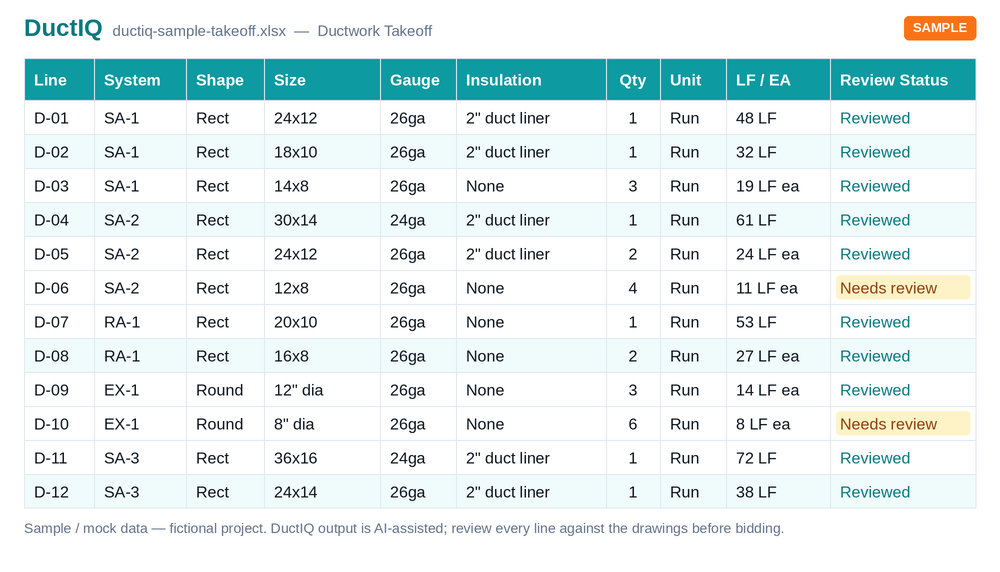
The deliverable: priceable Excel, downloadable right now
A takeoff is only as useful as the file your pricing can consume. DuctIQ exports structured Excel and CSV — duct by system and size with gauge and linear feet, fittings, air devices, and equipment in their own sections, plus sheet-metal weights — in one click, with nothing locked in a proprietary format.
Judge it against whatever any other tool shows you: this sample comes from the real export pipeline, no account required.
Download the sample takeoff (Excel)Download the CSV versionRun a free takeoff on your own drawing
How to evaluate a two-week-old takeoff model
Handoff publishes benchmark blueprint sets with ground truth on research request — so use that openness. Ask for the mechanical rows of those benchmarks specifically: how does H1 score on duct linear feet, fitting counts, and equipment identification, not just overall material capture? Then run the decisive test, which no benchmark replaces: the same mechanical PDF through both tools, compared line by line against your own numbers.
DuctIQ's side of that test costs nothing — the first takeoff is free and the sample export above shows the output format before you even start.
Start your free takeoffSee pricing & plans
Run your first takeoff free
Upload a mechanical PDF and get a reviewable ductwork, fittings, and equipment takeoff you can export to Excel. No credit card to try your first drawing.
Start your free takeoff Download a sample takeoff See pricingNew to AI takeoff and want a hand? Send us your first drawing and we'll help you review the output, or book a 1:1 walkthrough.
Related HVAC takeoff guides
Frequently asked questions
What is Handoff H1?
H1 is an AI model announced by Handoff on July 21, 2026, positioned as the first AI for autonomous blueprint takeoffs: it reads a drawing set and produces a complete material takeoff across trades, with benchmark sets available to researchers. It is a generalist model rather than a mechanical-specific tool — verify current capabilities with Handoff, as the product is very new.
Is DuctIQ an alternative to Handoff for HVAC takeoff?
For the HVAC ductwork scope, yes — and a deeper one. DuctIQ produces fitting-level duct takeoffs with SMACNA-aware gauge, pounds by gauge, reviewable line items, and structured Excel/CSV export, and it is in production today. Handoff's H1 targets general material takeoff across trades; duct-level output is not described in its launch materials.
Does an autonomous takeoff mean I don't review it?
No — no takeoff, however produced, should reach a bid unaudited. The practical question is whether the tool makes review fast. DuctIQ builds it in: statuses on every line, low-confidence reads flagged with reasons, and sheet-level traceability, so you audit targeted lines instead of re-measuring the set.
Can Handoff do SMACNA gauges and sheet-metal pounds?
Its launch materials do not describe SMACNA gauge, seam, or weight output — ask Handoff directly and get the answer in writing. DuctIQ resolves gauge per run (spec first, labelled SMACNA minimum otherwise) and computes pounds from published galvanized lb/ft² tables, the same ones behind our free duct weight calculator.
How should I compare the two on a real project?
Run one mechanical set through both. Ask Handoff for a live session on your drawings and for the mechanical rows of its published benchmarks; run the same PDF through DuctIQ free and review the takeoff line by line. Compare fitting counts, gauge handling, pounds, and how each result survives your own audit.
What does DuctIQ cost compared to Handoff?
DuctIQ's pricing is published: $29.99–$99.99 per month, cancel anytime, with non-expiring credit top-ups and a free first takeoff. Handoff's H1 pricing was not published in detail at launch — confirm on their site and get any figure in writing during a demo.