A Takeoff Boost Alternative Built Only for HVAC Ductwork
Takeoff Boost is ConstructConnect's AI takeoff assist — computer-vision automation for measuring, counting, and scaling that now ships inside ConstructConnect Takeoff and PlanSwift. If you use either platform, you have probably been pitched it as the AI upgrade. It is a genuine improvement over clicking every item by hand, and this page is a fair comparison, not a dismissal.
The question for an HVAC estimator is different, though: is the best next step an AI assist inside a general multi-trade tool, or a tool where the mechanical takeoff is the whole product? DuctIQ is the second thing — upload the mechanical PDF and the ductwork comes back measured, classified by system and size, fittings and equipment included, as line items you review and export to Excel. Below is where each approach wins.
Start your free takeoffSee pricing
No credit card — your first takeoff is free. Want proof first? Download a real sample takeoff — no signup.
What Takeoff Boost is (and what it is not)
ConstructConnect launched Takeoff Boost in 2026 as an AI-assisted, computer-vision powered takeoff capability, and per PlanSwift's May 2026 release notes it now ships inside the mainline product: Auto Takeoff returns a page's linear, area, and count takeoff in seconds, with Auto Scale detection and AI-powered auto-naming following over the summer. That is real, shipped automation of the click work — the estimator supervises a fast first pass instead of drawing every measurement. Details and packaging keep evolving; verify the current feature set with ConstructConnect.
Notice the units, though: linear, area, and count. That is geometry — and geometry is not ductwork. What it is not, and does not claim to be, is a mechanical estimator: no duct gauge, no seam logic, no fitting types, no SMACNA weights. The drawing understanding an HVAC bid actually turns on — which line is a supply trunk and which is a return, what the schedule says an RTU-3 is, where a duct changes size mid-run — stays with you, the same as before, just faster.
Assisted clicking vs an automated mechanical takeoff
It helps to name the two categories precisely. Takeoff Boost belongs to the first: AI acceleration of a takeoff the estimator still drives, inside a platform that covers every trade. DuctIQ belongs to the second: the software performs the HVAC takeoff itself — reading sheets, measuring duct at scale, counting fittings, pulling equipment from schedules — and the estimator's job shifts from producing quantities to auditing them.
Neither category is universally better. The first keeps one tool across all your trades; the second gets one trade — ductwork — to a reviewable number with far less operator time. Which one pays off depends on what your bids are made of.
When turning on Takeoff Boost is the right call
If your shop already lives in ConstructConnect Takeoff or PlanSwift and bids several trades from the same drawing sets, enabling the AI assist you already have access to is the obvious, low-friction move. There is no new tool to learn, no workflow change, and the speedup applies to every trade you measure, not just mechanical.
If HVAC is a minor line on mostly-general bids, that breadth beats specialization — a duct-only tool cannot help your concrete takeoff, and juggling two tools for one small trade rarely pays.
When an HVAC-specific tool is the better upgrade
If mechanical work is most of what you bid, the arithmetic flips: the hours are in the ductwork, and an assist that makes clicking faster still leaves the interpretation — systems, sizes, fittings, schedules — as manual work on every sheet.
- Your estimators spend their week on mechanical sets, not spread across trades.
- You want supply, return, and exhaust separated and rolled up by size without organising it yourself.
- You want fittings counted and equipment read from the schedules by tag, not tallied by eye.
- You want each AI read to carry a confidence flag, so review effort goes where the uncertainty is.
- You want the deliverable as structured Excel/CSV — system, size, gauge, quantity — priced in the workbook you already use.
Side by side on a ductwork bid
Take one mid-size commercial mechanical set and run it through both approaches. The contrast is not speed of clicking — it is how much of the takeoff exists before an estimator touches anything.
| On a mechanical set | Takeoff Boost inside ConstructConnect / PlanSwift | DuctIQ |
|---|---|---|
| Starting point | AI accelerates the measuring you set up and supervise | Upload the PDF; the takeoff is produced for you |
| Duct systems and sizes | Trade-agnostic geometry — you assign SA/RA/EA and sizes | Classified and grouped by system and size automatically |
| Fittings and devices | Faster counting, still your pass to run | Counted with the duct, listed as line items |
| Equipment schedules | Read and keyed by the estimator | Pulled from the schedules by tag |
| Knowing what to double-check | Your judgement across the whole set | Low-confidence reads flagged with reasons, queued first |
| Deliverable | Measured quantities you organise for pricing | Structured Excel/CSV ready to price, plus SMACNA-aware shop output |
Fair at the category level: Takeoff Boost is a real accelerator for a generalist workflow; DuctIQ removes the workflow for one trade. Verify current Takeoff Boost specifics with ConstructConnect.
Review is the product, not an afterthought
Any AI takeoff — assisted or automated — is only biddable after a human has audited it. DuctIQ is built around that audit: every duct run, fitting, air device, and piece of equipment returns as a line item with a Review Status, low-confidence reads are flagged with the reason, and a review queue puts the uncertain lines first so your attention lands where the risk is.
Each line traces back to its source sheet, and nothing exports until you have confirmed it. That is the difference between reviewing a takeoff and re-doing one.
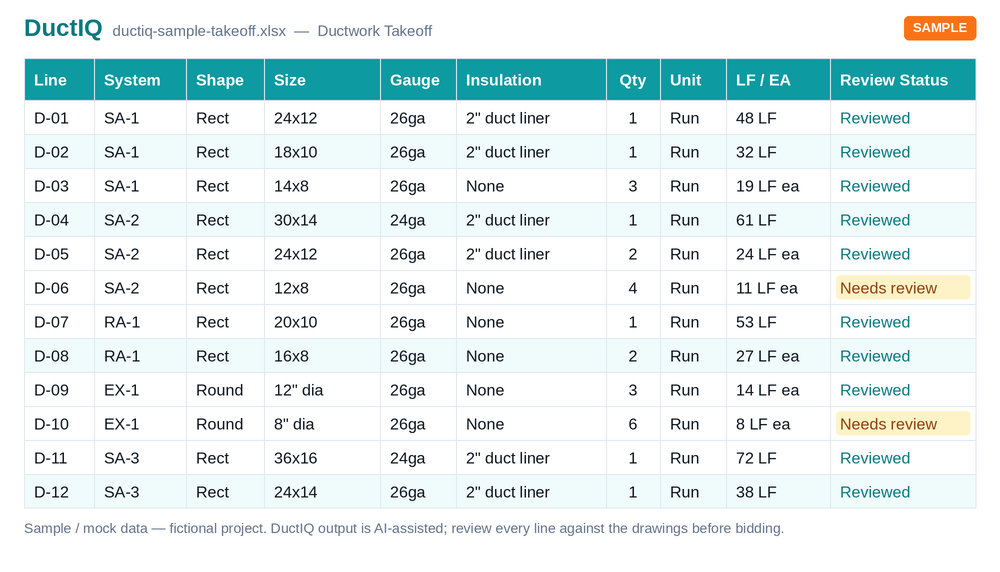
The deliverable: Excel your pricing already understands
DuctIQ's output is a structured Excel or CSV file — duct by system and size with gauge and linear feet, fittings, air devices, and equipment in their own sections — generated in one click. It drops into the estimating workbook you already price in, whether or not that workbook was ever connected to ConstructConnect or PlanSwift, and nothing about your historical estimates gets locked in anywhere.
You can judge the format before creating an account — this sample is produced by the real export pipeline:
Download the sample takeoff (Excel)Download the CSV versionHow the export is structured
Run the experiment on your next bid
You do not have to choose in the abstract, and you do not have to leave your platform to find out. On your next mechanical bid, run the duct portion through DuctIQ alongside your normal Takeoff Boost-assisted pass: upload the same PDF, compare linear feet per system, fitting counts, and equipment against your own numbers, and time both. The first takeoff is free and the sample export above shows the deliverable before you even do that.
Keep whichever process you trust. If the general assist wins for your mix of work, you have lost an hour; if the mechanical-specific takeoff wins, you have found the hours in every future bid.
Start your free takeoffSee pricing & plans
Run your first takeoff free
Upload a mechanical PDF and get a reviewable ductwork, fittings, and equipment takeoff you can export to Excel. No credit card to try your first drawing.
Start your free takeoff Download a sample takeoff See pricingNew to AI takeoff and want a hand? Send us your first drawing and we'll help you review the output, or book a 1:1 walkthrough.
Related HVAC takeoff guides
Frequently asked questions
What is Takeoff Boost?
Takeoff Boost is ConstructConnect's AI takeoff assist, launched in 2026 and now included with its takeoff products including PlanSwift. As marketed, it uses computer vision to automate the click work of a takeoff — measuring, counting, scaling, and bookmarking — as a faster first pass the estimator still supervises. Confirm current capabilities and packaging with ConstructConnect.
Is Takeoff Boost the same thing as PlanSwift?
No — PlanSwift is the takeoff platform; Takeoff Boost is the AI assist ConstructConnect has added to it (and to ConstructConnect Takeoff). If you are comparing DuctIQ with the PlanSwift platform as a whole, see our dedicated PlanSwift comparison page.
How is DuctIQ different from Takeoff Boost for HVAC?
Takeoff Boost accelerates a trade-agnostic takeoff you still drive — you assign systems, organise sizes, and read schedules yourself, faster. DuctIQ performs the HVAC takeoff: it classifies supply, return, and exhaust, measures duct by size, counts fittings, pulls equipment from schedules, flags low-confidence reads for review, and exports structured Excel/CSV.
Do I need PlanSwift or ConstructConnect to use DuctIQ?
No. DuctIQ is standalone: upload a mechanical PDF in the browser and review the takeoff there. Because it exports standard Excel and CSV, it also coexists fine with either platform if the rest of your shop keeps using them for other trades.
Can I compare DuctIQ against my Takeoff Boost workflow before paying?
Yes — that is the recommended path. Download the sample Excel takeoff with no account to inspect the deliverable, then run your first takeoff free on one of your own mechanical drawings and compare quantities and time against your assisted pass.
Does DuctIQ cover trades other than HVAC?
No — deliberately. DuctIQ only does HVAC mechanical ductwork takeoff: duct, fittings, air devices, and equipment. If you need AI assistance across concrete, framing, and finishes too, a general assist like Takeoff Boost serves that breadth; DuctIQ's value is depth on the mechanical trade.