An Accubid Anywhere Alternative for HVAC Duct Takeoff
Try AI Takeoff Free
No credit card · Upload a PDF in 10 seconds · Runs in your browser on Mac or Windows
Try AI Takeoff FreeSee an AI Takeoff in 10 Seconds
The sample is a real DuctIQ takeoff workbook: no signup. Plans and credits are on the pricing page.
Trimble's Accubid line is the estimating incumbent in MEP, and in July 2026 it shipped real AI into Accubid Anywhere: automatic scale detection across a plan set, symbol recognition for device counts, conduit auto-routing with rises and drops, and an AI assistant for historical pricing. Trimble cites up to 60% time savings on takeoff tasks and thousands of contractors already using its MEP AI tools. That is a genuine release from a serious vendor, and this page treats it that way.
Look at that feature list through a sheet metal estimator's eyes, though, and a pattern shows: symbols and conduit are electrical-first wins. The ductwork half of a mechanical bid — sizing tags read off the plan, fittings counted by type, SMACNA gauge resolved per run, pounds by gauge — is exactly what DuctIQ does, self-serve, with every quantity as a reviewable line and a structured Excel export. If you run Accubid and duct is where your takeoff hours go, this comparison is for you.
What Trimble shipped in July 2026 — credit where due
Accubid Anywhere's AI release is aimed at the whole MEP estimating workflow: auto-scale detection means less manual calibration per sheet, symbol recognition accelerates device counting, conduit auto-routing (including rises and drops) attacks the most tedious part of an electrical takeoff, and the pricing assistant mines your own estimate history. For a shop already living in the Accubid ecosystem — its databases, its pricing services, its Trimble integrations — these land inside a workflow you have already paid to build.
Verify the specifics with Trimble, as the release is new and moving. The fair question this page asks is narrower: which of those capabilities measure ductwork?
The duct gap: symbols and conduit are not sheet metal
Recognising a receptacle symbol and routing conduit are different problems from reading a mechanical plan's ductwork. A duct takeoff needs the size tags on the runs read and applied, the runs measured at scale by system, fittings derived where the geometry turns, branches, and changes size, gauge resolved against the spec or the SMACNA minimums, and pounds computed from the gauge — because sheet metal is priced and fabricated by the pound, not the symbol.
Trimble's July release notes lead with none of that, which is not a criticism of an electrical-leaning roadmap — it is the gap a mechanical estimator has to check before assuming "AI takeoff" covers their trade. Ask to see a full duct takeoff, fittings and gauge included, on your own drawing set before counting those hours as saved.
Start your free takeoffOr download a real sample takeoff first
When staying on Accubid makes sense
If your shop's estimating lives in Accubid's databases — assemblies, labour factors, vendor pricing — and your work skews electrical or you bid all of MEP from one platform, the integrated ecosystem is a real asset and the new AI features compound it. Ripping out an estimating platform over the duct portion alone is rarely the right call, and this page does not suggest it.
DuctIQ is not an estimating platform replacement; it is the duct takeoff done properly. Because it exports standard Excel/CSV, its output feeds whatever prices your bids — including an Accubid workflow. The realistic move for most Accubid mechanical shops is addition, not migration.
When DuctIQ earns a place beside it
Bring DuctIQ in when the ductwork is where the takeoff hours actually go:
- Your estimators still hand-measure duct runs and hand-count fittings while the AI handles the electrical scope.
- You need duct sizing tags read from the plan and applied per run, not just geometry measured.
- You need fittings as typed, priceable counts — elbows, tees and taps, reducers and transitions — derived from the runs themselves.
- You need SMACNA-aware gauge on every line (spec first, labelled minimum otherwise) and pounds by gauge for sheet metal pricing.
- You want each quantity reviewable — flags with reasons, sheet traceability — before it exports into your estimate.
Six rows that decide the duct half of the bid
Score both tools on the duct-specific work. Where Accubid Anywhere's public materials are silent on a row, the honest cell is what to verify in a demo — on your own mechanical set, not a sample.
| Duct capability | Accubid Anywhere + AI (verify in a demo) | DuctIQ (verifiable today) |
|---|---|---|
| Duct sizing tags | Ask whether size callouts are read and applied per run | Read from the plan and applied — runs grouped by system and size |
| Auto fittings | Ask for fitting-level duct output; the release leads with symbols and conduit | Elbows, tees/taps, reducers/transitions derived from the traced runs, counted by type |
| SMACNA gauge & weight | Not described in the July release — ask how gauge and pounds are produced | Spec gauge first, labelled SMACNA minimum otherwise; pounds from published lb/ft² tables (check them on our duct weight calculator) |
| Review before export | Ask how an estimator audits and corrects AI reads | Review Status on every line; low-confidence reads flagged with reasons, confirmed before export |
| Excel / CSV export | Estimate lives in the Accubid ecosystem; ask what exports and how | One-click structured .xlsx/CSV — feeds any pricing workflow, Accubid's included; sample downloadable below |
| Setup time | Platform onboarding, databases, and training — an ecosystem investment | Upload a PDF in the browser; first reviewable takeoff in minutes, first one free |
Fair under uncertainty: Trimble's July 2026 release is real and its electrical strengths are credited above — the middle column lists what a mechanical shop should verify rather than claims about what is missing.
Reviewable quantities, because the bid is still yours
Whatever produces a takeoff — Trimble's AI, DuctIQ's, or a scale ruler — an estimator signs the bid. DuctIQ is built around that: every duct run, fitting, air device, and piece of equipment comes back as a line item with a Review Status, low-confidence reads are flagged with the reason and queued first, and each line traces to its source sheet. You confirm before anything exports.
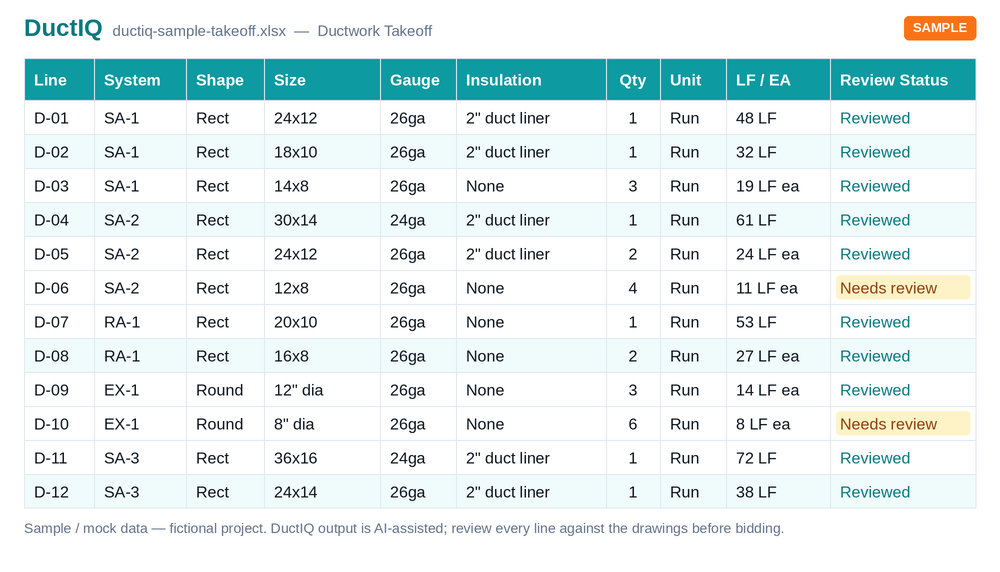
Excel out — into whatever prices your bid
DuctIQ's deliverable is a structured Excel or CSV file: duct by system, size, and gauge with linear feet, typed fitting counts, equipment and air devices, and sheet-metal weights. It drops into a pricing workbook, an estimating platform import, or an Accubid-based workflow without re-keying — no lock-in in either direction.
The sample below is produced by the real export pipeline; compare it against whatever a platform demo shows you:
Download the sample takeoff (Excel)Download the CSV versionHow DuctIQ compares across tool categories
Run the test that settles it
Take one mechanical set you have already bid. Ask your Trimble contact to run the duct scope through Accubid Anywhere's AI live; upload the same PDF to DuctIQ (the first takeoff is free). Compare duct linear feet by system, fitting counts by type, gauge handling, and pounds against the numbers you already trust — and count the estimator-minutes each path took.
If the platform's AI covers your duct scope, you have lost an hour and gained certainty. If it doesn't, DuctIQ slots in beside it for exactly the work it leaves on your desk.
Start your free takeoffSee pricing & plans
Run your first takeoff free
Upload a mechanical PDF and get a reviewable ductwork, fittings, and equipment takeoff you can export to Excel. No credit card to try your first drawing.
Start your free takeoff Download a sample takeoff See pricingNew to AI takeoff and want a hand? Send us your first drawing and we'll help you review the output, or book a 1:1 walkthrough.
Related HVAC takeoff guides
Frequently asked questions
Did Accubid add AI takeoff?
Yes — Trimble shipped AI features into Accubid Anywhere in July 2026: automatic scale detection, symbol recognition for device counts, conduit auto-routing with rises and drops, and an AI assistant for historical pricing, citing up to 60% time savings on takeoff tasks. Verify the current feature set with Trimble; the release is new and evolving.
Does Accubid's AI do ductwork takeoff?
Its July 2026 release materials lead with electrical-first capabilities — symbols and conduit — and do not describe duct sizing tags, fitting-level duct output, or SMACNA gauge and weight. That may change; ask Trimble to demonstrate a full duct takeoff on your own drawings. DuctIQ exists precisely for that duct-specific scope.
Is DuctIQ a replacement for Accubid?
No — Accubid is an estimating platform; DuctIQ is a duct takeoff engine. DuctIQ measures the ductwork, counts fittings, resolves gauge, and computes pounds, then exports structured Excel/CSV that feeds whatever prices your bid, an Accubid workflow included. For most Accubid mechanical shops the sensible move is addition, not migration.
How does DuctIQ handle SMACNA gauge and duct weight?
Gauge is resolved per run — from the project spec when stated, from SMACNA low-pressure minimums when not, labelled as a minimum so it is never mistaken for a verified value. Pounds come from published galvanized lb/ft² tables by gauge, the same ones behind DuctIQ's free duct weight calculator, so any line can be checked by hand.
What does switching the duct takeoff to DuctIQ involve?
Nothing platform-shaped: you upload the mechanical PDF in the browser, review the takeoff line by line, and export Excel/CSV. There is no database migration and no training program — the first takeoff is free, and the sample export on this page shows the deliverable before you even sign up.
What does DuctIQ cost next to a platform licence?
DuctIQ's pricing is published: $29.99–$99.99 per month in CAD, cancel anytime, with non-expiring credit top-ups. Platform licences and their AI tiers vary by contract — get current Trimble figures from your account rep and compare against a subscription that costs less per month than an estimator-hour.