A FastDUCT Alternative When You Want the Duct Measured for You
Free preview takeoff
One sheet · About half the rows · CSV export · No credit card · Runs in your browser on Mac or Windows
Try a Free Preview TakeoffSee an AI Takeoff in 10 Seconds
The sample is a real DuctIQ takeoff workbook: no signup. Plans and credits are on the pricing page.
FastDUCT, from FastEST Inc. in Wichita, Kansas, has been a sheet metal estimating tool for many years. Its listings describe a large parts catalog, job templates, and reports in pounds, square feet, material cost and field labour hours, with takeoff done on digital plans. For a shop that wants one system to take off and price duct, that is a reasonable thing to look at.
This page is for the estimator whose bottleneck is the takeoff itself: clicking along every run on the PDF. DuctIQ reads the mechanical PDF and returns duct linear feet by system and size, fittings counted by type, air devices and equipment from the schedules, and spec-first gauge with the SMACNA minimum labelled. Every line is reviewable, then it exports to Excel or CSV for you to price however you already do. Below is a fair comparison.
What FastDUCT is built for
FastDUCT is an estimating system. Its strength, as FastEST and its listings present it, is turning a takeoff into a priced estimate: a catalog of duct items and fittings, labour units, and reports that roll up pounds of sheet metal and field hours. Many sheet metal contractors have built their pricing inside it.
The takeoff in a system like this is done by the estimator, who traces the runs on the plan and assigns items. If that tracing is where your hours go, ask in a demo how much of it the software does for you on a real mechanical set. Verify features and pricing directly with FastEST, because listings change.
An estimating system vs an AI duct takeoff
The trade-off is where the work happens. An estimating system gives you depth on pricing once the quantities are in. DuctIQ works one step earlier: it produces the quantities from the drawing so nobody has to trace them.
DuctIQ runs in any modern browser, there is nothing to install, and your first takeoff is a free preview (one sheet, about half the rows, CSV) with no credit card. Upload a mechanical PDF, review the lines it flags, and export a structured workbook. Nothing about your pricing lives inside DuctIQ.
Start your free preview takeoffOr download a real sample takeoff first
Side by side on the duct takeoff
Score both on the ductwork itself. Where a detail is not in public materials, the cell says what to ask in a demo:
| Capability | FastDUCT (verify in a demo) | DuctIQ (verifiable today) |
|---|---|---|
| What it is | Duct estimating system with a parts catalog and labour units | Browser-based AI HVAC ductwork takeoff |
| Who does the takeoff | The estimator traces runs on digital plans; ask what is automated | The software measures duct LF by system and size and counts typed fittings |
| Gauge and weight | Pounds and square feet in its reports | Spec-first gauge, SMACNA minimum labelled; pounds from published tables |
| Pricing and labour | Material cost and field labour hours, its core strength | Not included: DuctIQ exports quantities for your own pricing |
| Review | Ask how the takeoff is checked | Every line has a Confidence level and its source sheet; unsure reads are flagged |
| Output | A FastDUCT estimate and reports | Structured Excel or CSV, sample downloadable below |
Fair under uncertainty: FastDUCT's estimating depth is credited; cells we cannot verify say what to ask.
Where the hours go on a duct bid
On a mechanical set heavy with ductwork, measuring is the slow part: scaling every run, separating supply, return and exhaust, counting each elbow, tee and transition, and reading tags against the schedules. DuctIQ does that step and hands you a finished list to audit, with the low-confidence reads flagged first. Detail sheets and schedules are used to resolve tags, not measured again, so the footage reflects the plan views only.
Use it in front of the system you already price in
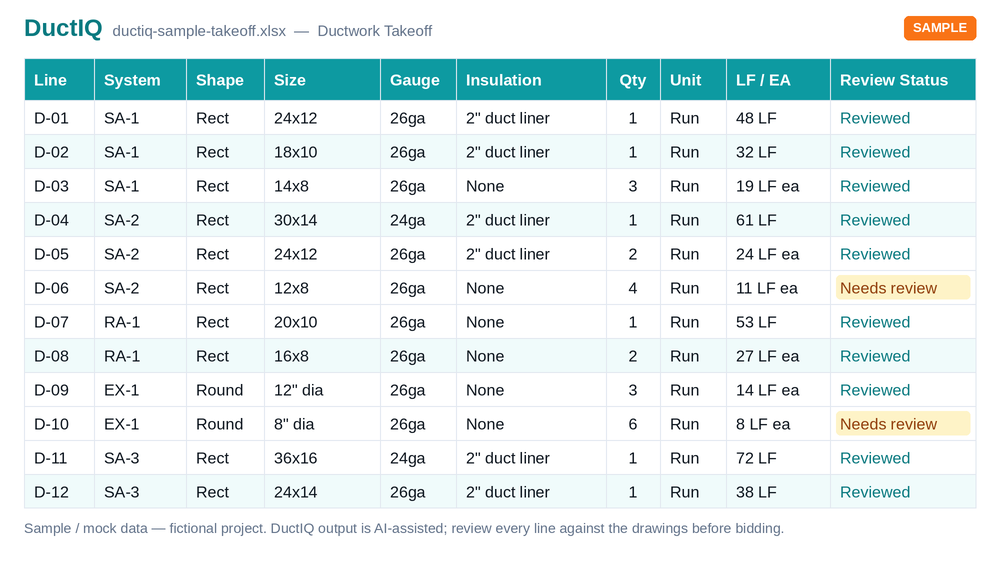
Because DuctIQ exports plain Excel and CSV, it can sit in front of the estimating system you already use. The workbook has one sheet per category: Equipment, Ductwork with fittings, GRD for diffusers and grilles, Dampers, Piping, Controls and a Summary. Judge the file before creating an account:
Download the sample takeoff (Excel)Download the CSV versionHow the export is structured
Settle it on one real bid
Take a mechanical set you have already taken off in FastDUCT. Upload the same PDF to DuctIQ, then compare duct footage by system and size, fitting counts and air-device counts against your numbers, and note the time from opening the file to a usable quantity list. Keep whichever survives your audit.
Run a free preview takeoff on your own drawingSee pricing & plans
Start with a free preview takeoff
Upload a mechanical PDF and DuctIQ takes off one sheet as a free preview: about half the measured rows, with a CSV export, so you can judge the accuracy on your own drawing. No credit card. Paid plans return the complete takeoff with Excel.
Built by a practicing P.Eng and principal of an Ontario mechanical contracting firm, for the estimators at that firm.
Start your free preview takeoff Download a sample takeoff See pricingNew to AI takeoff and want a hand? Send us your first drawing and we'll help you review the output, or book a 1:1 walkthrough.
Related HVAC takeoff guides
Frequently asked questions
What is FastDUCT?
FastDUCT is a duct estimating system from FastEST Inc. in Wichita, Kansas, for sheet metal contractors. Its listings describe a parts catalog, job templates and reports in pounds, material cost and labour hours. Verify current features and pricing with FastEST.
Is DuctIQ a replacement for FastDUCT?
Not for everything. FastDUCT prices duct inside its own catalog; DuctIQ is an AI takeoff that measures the ductwork from the PDF and exports quantities to Excel. Many shops can use DuctIQ for the quantities and keep pricing where they price today.
Does DuctIQ price the job?
No. DuctIQ measures and counts from the drawings and exports the quantities. Your unit costs, labour rates and supplier pricing stay in your own system.
How do I compare the two fairly?
Use a set you have already taken off. Run the same PDF through DuctIQ and compare footage by system and size, fittings and air devices against your numbers, and the time each took.
Can I try DuctIQ before paying?
Yes. Your first takeoff is a free preview on your own drawing (one sheet, about half the rows, CSV) with no credit card, and the monthly plans are published on the pricing page.