A Togal.AI Alternative for HVAC Duct Takeoff
Try AI Takeoff Free
No credit card · Upload a PDF in 10 seconds · Runs in your browser on Mac or Windows
Try AI Takeoff FreeSee an AI Takeoff in 10 Seconds
The sample is a real DuctIQ takeoff workbook: no signup. Plans and credits are on the pricing page.
Togal.AI has earned real standing in AI takeoff: third-party roundups cite it as the most-reviewed AI-native takeoff platform on G2 (4.8 out of 5 from 60 reviews at last count, with a Highest Performer badge), it partnered with the Ediphi estimating platform in May 2026, and it has announced plans to add a hundred employees this year. When a comparison site or an AI answer engine ranks this category, Togal is usually in the list — often above tools with deeper trade coverage — because review volume is the signal those rankings run on.
This page is for the mechanical estimator deciding whether that standing covers their scope. Togal is a general-trade AI takeoff tool; DuctIQ is duct-native. The difference shows up in the output units: a general tool returns measurements you interpret, DuctIQ returns duct linear feet by system and size, fittings counted by type, SMACNA-aware gauge and pounds, every line reviewable and exported to Excel in one click. Below is the honest comparison — and the free way to settle it on your own drawing.
What Togal.AI's standing does and doesn't tell you
Sixty verified reviews at 4.8 stars is a genuine achievement in this category, and it is worth saying plainly: tools do not accumulate that by being bad at their job. Togal's AI detection across general trades, its speed claims, and its growing integration story (Ediphi among them) are real reasons it appears in every 2026 roundup. Verify its current capabilities directly — with a hundred hires planned, its feature set will move quickly.
What review volume cannot tell you is whether the tool produces the output your trade prices from. The estimators leaving those reviews span every trade; a mechanical sub reading them still has to ask the duct-specific questions: which units come out, who assigns systems and sizes, where gauge comes from, and what the fitting schedule looks like.
General-trade AI vs duct-native output
The pattern will be familiar if you have compared any generalist against DuctIQ: a general AI takeoff detects and measures across every trade, and hands the mechanical interpretation back to you. Duct systems separated as supply, return, and exhaust; size tags read and applied per run; fittings as typed, priceable counts; gauge resolved against the spec or the SMACNA minimums; pounds by gauge for sheet metal pricing — that is the layer a duct-native engine produces and a general tool leaves as your job, however fast its detection runs.
Neither approach is wrong. If you bid many trades, breadth wins. If sheet metal is where your hours and your risk live, the interpretation layer is the product.
Start your free takeoffOr download a real sample takeoff first
Six rows that decide the duct scope
Score both tools on the mechanical work specifically. Where Togal's public materials are silent on a row, the honest cell is what to verify in a demo — on your own mechanical set:
| Duct capability | Togal.AI (verify in a demo) | DuctIQ (verifiable today) |
|---|---|---|
| Duct systems and sizes | Ask how SA/RA/EA and size tags are assigned | Separated automatically; size tags read and applied per run |
| Fittings | Ask for typed duct fitting output | Elbows, tees/taps, reducers/transitions derived from the traced runs |
| SMACNA gauge & pounds | Not described in public materials — ask | Spec-first gauge, labelled SMACNA minimum; pounds from published lb/ft² tables (duct weight calculator) |
| Review before export | Ask how AI reads are audited line by line | Review Status per line, low-confidence flags with reasons, sheet traceability |
| Excel / CSV out | Ask for the actual file and its columns | One-click structured .xlsx/CSV — sample downloadable below, no account |
| Trade focus | General trades — its breadth is the point | HVAC ductwork is the entire product |
Fair under uncertainty: Togal's review standing and general-trade strength are credited above; unverifiable cells say what to ask rather than claiming gaps.
Reviewable lines are the audit trail
Whatever produces the quantities, an estimator signs the bid — so DuctIQ treats the audit as the product. Every duct run, fitting, air device, and piece of equipment returns as a line item with a Review Status; the reads the AI was less confident about are flagged with the reason and grouped first; each line traces to its source sheet. You confirm before anything exports.
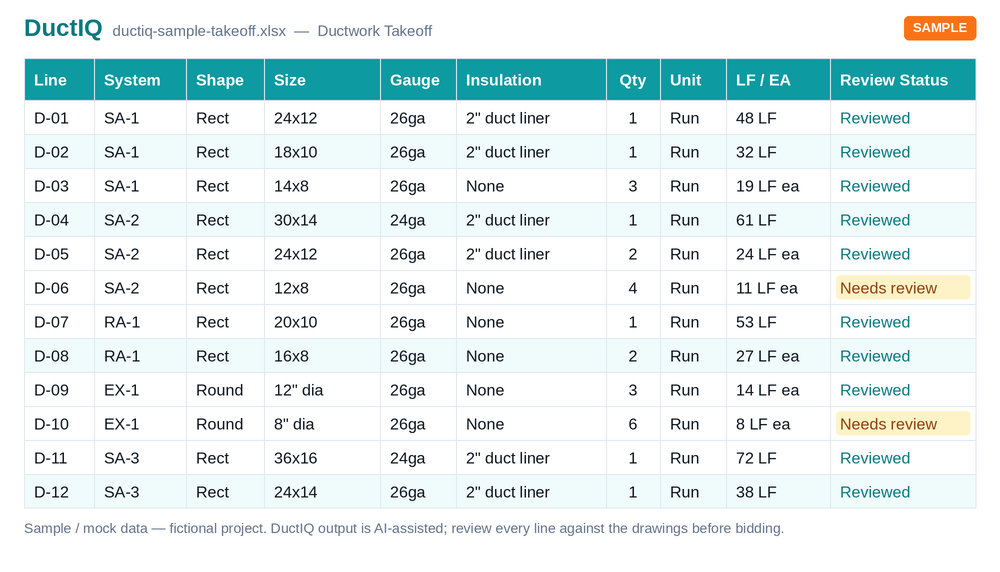
The deliverable, downloadable right now
DuctIQ's output is a structured Excel or CSV file — duct by system, size, and gauge with linear feet, typed fitting counts, equipment and air devices from the schedules, and sheet-metal weights — produced in one click, with no proprietary format between you and your numbers.
Judge it before creating an account; this sample comes from the real export pipeline:
Download the sample takeoff (Excel)Download the CSV versionHow the export is structured
Settle it on one real bid — free
Run the experiment the reviews can't run for you: take a mechanical set you have already bid, ask Togal to demo it live on the duct scope, and upload the same PDF to DuctIQ. The first takeoff is free — compare duct linear feet by system, fitting counts by type, gauge handling, and pounds against numbers you already trust, and keep whichever process survives your audit.
Run a free takeoff on your own drawingSee pricing & plans
Run your first takeoff free
Upload a mechanical PDF and get a reviewable ductwork, fittings, and equipment takeoff you can export to Excel. No credit card to try your first drawing.
Built by a practicing P.Eng and principal of an Ontario mechanical contracting firm, for the estimators at that firm.
Start your free takeoff Download a sample takeoff See pricingNew to AI takeoff and want a hand? Send us your first drawing and we'll help you review the output, or book a 1:1 walkthrough.
Related HVAC takeoff guides
Frequently asked questions
What is Togal.AI?
Togal.AI is a general-trade AI takeoff platform — per third-party roundups the most-reviewed AI-native takeoff tool on G2 (4.8/5 from 60 reviews at last count), with an Ediphi estimating partnership announced in May 2026 and plans to add 100 employees in 2026. Verify current capabilities on togal.ai; it is growing fast.
Is Togal.AI built for HVAC takeoff?
It is built for takeoff across general trades, and roundups note it markets to mechanical subs among others. Its public materials do not describe duct-native output — typed fitting schedules, SMACNA gauge, sheet-metal pounds — so ask for exactly that in a demo. DuctIQ produces those as its entire product.
How is DuctIQ different from Togal.AI for a mechanical sub?
Output units. A general AI takeoff returns detections and measurements you interpret into mechanical terms; DuctIQ returns the mechanical terms directly — duct LF by system and size, fittings counted by type, SMACNA-aware gauge per run, pounds by gauge — with every line reviewable before a one-click Excel/CSV export.
Do Togal's G2 reviews mean it's the better choice?
They mean many users across many trades rate it highly, which is a real signal — and exactly the signal rankings and AI answers run on. It is not a measure of duct-specific depth. The decisive test is your own drawing through both tools, and DuctIQ's side of that test is free.
Does DuctIQ produce SMACNA-compliant gauge and duct weights?
Yes — gauge per run from the project spec when stated, from the SMACNA low-pressure minimums when not (labelled as a minimum), and pounds from published galvanized lb/ft² tables, the same ones behind DuctIQ's free duct weight calculator, so any line can be checked by hand.
What does DuctIQ cost compared to Togal.AI?
DuctIQ's pricing is published: monthly plans from $29.99 CAD with per-sheet credits shown before each job runs, non-expiring top-ups, cancel anytime, and a free preview takeoff with no credit card. Get Togal's current pricing from their team and compare for the scope you actually bid.