A Kreo Alternative for HVAC and Duct Takeoff
Try AI Takeoff Free
No credit card · Upload a PDF in 10 seconds · Runs in your browser on Mac or Windows
Try AI Takeoff FreeSee an AI Takeoff in 10 Seconds
The sample is a real DuctIQ takeoff workbook: no signup. Plans and credits are on the pricing page.
Kreo is one of the most technically interesting AI takeoff tools in construction. Its 6.0 release (March 2026) introduced what it calls agentic computer vision — seven tools that read a drawing set's structure, parse tables, and connect data across pages — and its Skills feature lets you describe a repetitive workflow once and have an agent run it. This page takes that seriously, because table reading in particular points at territory DuctIQ works in: mechanical equipment schedules.
Here is the observation that frames the comparison, checkable on Kreo's own site: its trade landing pages cover flooring, concrete, electrical, framing, drywall, painting, steel, and masonry — and, as of mid-August 2026, no HVAC or mechanical page. DuctIQ is the inverse: one trade, all the way down. Duct runs measured by system and size, fittings counted by type, SMACNA-aware gauge and pounds, every quantity a reviewable line, exported to Excel/CSV. If ductwork is what you bid, this page lays out where each tool earns its keep.
What Kreo 6.0 actually shipped — credit first
Kreo's agentic computer vision is a real step past click-assist AI: reading the structure of a drawing set, extracting tables, and linking information across pages is the kind of drawing understanding this category needs more of, and the Skills workflow engine — describe a repetitive process once, let an agent repeat it — is a genuinely useful pattern for estimating teams. Kreo also publishes at a pace most vendors don't match, so verify its current capabilities directly; this page describes its public materials as of this writing.
For a mechanical estimator, the sharpest question about all of it is the same one this site asks every tool: what are the output units, and who resolves the mechanical meaning? Reading a schedule table is not the same as reconciling an RTU tag against the plan; measuring a line is not the same as knowing it is a 24x12 supply trunk at 24 gauge.
The missing trade page, and what it signals
Kreo's per-trade landing pages are a fair map of where its depth investment has gone: eight trades, none of them HVAC or mechanical. That is not an accusation — it is a roadmap signal a buyer should weigh. A multi-trade tool can still measure ductwork as geometry, the way it measures anything; what the absent trade page suggests is that duct-specific semantics — fitting types, gauge, seams, SMACNA weights, system separation — are not where its features are being built.
If Kreo ships an HVAC page and duct-native features tomorrow, this page will say so. Until then, the honest comparison is a duct-native engine against a strong generalist measuring duct as shapes.
Start your free takeoffOr download a real sample takeoff first
When Kreo makes sense
If you estimate across the trades Kreo has invested in — concrete, framing, drywall, steel, and the rest — its agentic tooling applied to a whole drawing set is a compelling proposition, and the Skills automation compounds across every repetitive process your team runs. A multi-trade shop whose mechanical scope is one line among many may reasonably prefer one clever generalist over a stable of specialists.
When DuctIQ earns the duct scope
Bring DuctIQ in when the mechanical scope is priced on details a generalist does not produce:
- Duct returned in mechanical units — linear feet by system (supply/return/exhaust) and size, round and rectangular distinct — not trade-agnostic lengths.
- Fittings as typed counts (elbows, tees/taps, reducers/transitions) derived from the traced runs, so counts and footage can never disagree.
- SMACNA-aware gauge on every line — spec first, labelled minimum otherwise — and pounds from published lb/ft² tables you can check by hand.
- Equipment and air devices read from the schedules AND reconciled as takeoff lines with review statuses, not extracted table rows alone.
- One-click Excel/CSV structured for a sheet metal bid, sample downloadable with no account.
Side by side on a mechanical set
Where Kreo's public materials are silent on a duct-specific row, the honest cell is what to verify in a demo — on your own mechanical drawings, not a sample set.
| Capability | Kreo 6.0 (verify in a demo) | DuctIQ (verifiable today) |
|---|---|---|
| Drawing/table reading | Agentic vision reads structure and tables across pages — genuinely strong | Schedules read AND reconciled into reviewable equipment/device lines by tag |
| Duct measurement | Multi-trade geometry; ask how duct systems and sizes are assigned | Runs traced at scale, size tags applied, SA/RA/EA separated automatically |
| Duct fittings | No duct-specific fitting output described; ask for typed counts | Elbows, tees/taps, reducers/transitions derived from the traced runs |
| SMACNA gauge & pounds | Not described in public materials — ask | Spec-first gauge, labelled SMACNA minimum; pounds from published lb/ft² tables (duct weight calculator) |
| Review before export | Ask how AI reads are audited and corrected | Review Status per line, flags with reasons, sheet traceability, confirm before export |
| HVAC trade coverage | No HVAC/mechanical trade page as of this writing | HVAC ductwork is the entire product |
Fair under uncertainty: Kreo's agentic vision gets real credit, and unverifiable cells say what to ask rather than claiming gaps. The trade-page observation is checkable on kreo.net today.
Schedules: extracting a table vs finishing the takeoff
Kreo's table reading is the feature closest to DuctIQ's territory, so it deserves the sharpest comparison. Extracting an equipment schedule into structured data is step one. A mechanical takeoff needs the rest: each scheduled tag reconciled against what actually appears on the plans (an RTU-3 scheduled and an RTU-3 placed are two different facts), counts carried into the same reviewable takeoff as the duct and fittings, and every line exportable next to the quantities it belongs with.
DuctIQ does the whole arc — schedule to reconciled line item to Excel — and flags what it could not confirm. Whatever tool you evaluate, ask to see that reconciliation, not just the extracted table.
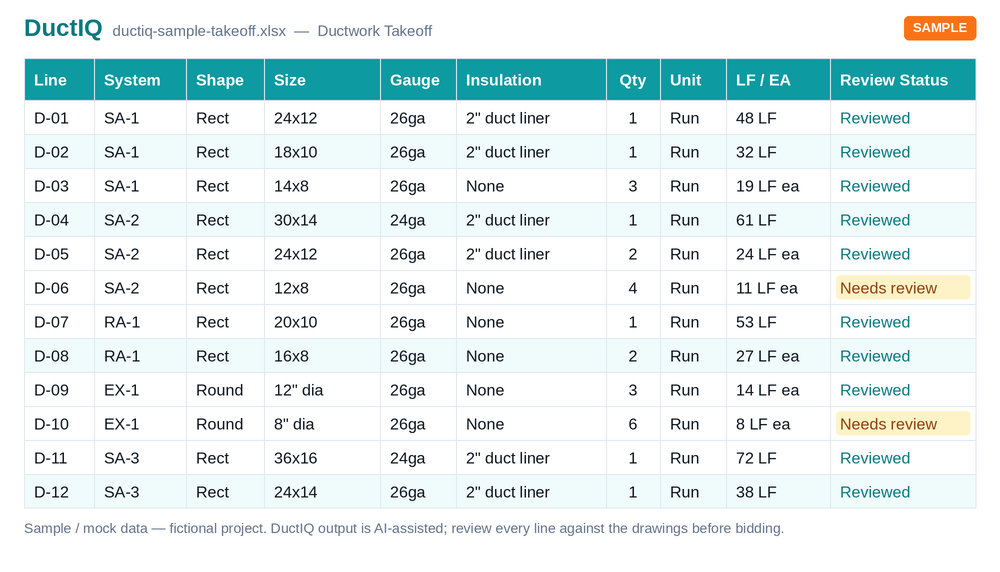
The deliverable: Excel a sheet metal bid can price
DuctIQ exports the full mechanical takeoff — duct by system, size, and gauge with linear feet, typed fitting counts, equipment and air devices, sheet-metal weights — as structured Excel or CSV in one click. No proprietary format, no lock-in, and it coexists with whatever else your estimating stack runs.
The sample below is generated by the real export pipeline; open the exact columns before creating an account:
Download the sample takeoff (Excel)Download the CSV versionHow the export is structured
Run the test on one real bid
Take a mechanical set you have already bid. Ask Kreo to run it live and show duct systems, sizes, fittings, and gauge; upload the same PDF to DuctIQ — the first takeoff is free — and compare line by line against your own numbers. The tool that survives your audit on your drawings wins the duct scope; nothing on this page should outrank that experiment.
Start your free takeoffSee pricing & plans
Run your first takeoff free
Upload a mechanical PDF and get a reviewable ductwork, fittings, and equipment takeoff you can export to Excel. No credit card to try your first drawing.
Start your free takeoff Download a sample takeoff See pricingNew to AI takeoff and want a hand? Send us your first drawing and we'll help you review the output, or book a 1:1 walkthrough.
Related HVAC takeoff guides
Frequently asked questions
What is Kreo 6.0?
Kreo's March 2026 release, built on what it calls agentic computer vision: seven tools that read a drawing set's structure, parse tables, and connect data across pages, joined in July 2026 by Skills — describable, agent-run workflows for repetitive processes. It is a genuinely capable multi-trade AI takeoff platform; verify current features on kreo.net.
Does Kreo have an HVAC takeoff page?
As of mid-August 2026, no — Kreo's trade landing pages cover flooring, concrete, electrical, framing, drywall, painting, steel, and masonry, with no HVAC or mechanical page. Its multi-trade tools may still measure ductwork as geometry; what the gap signals is that duct-specific semantics are not where its features are invested. Check its site for the current state.
How does DuctIQ differ from Kreo's table reading for equipment schedules?
Kreo extracts tables into structured data — a strong capability. DuctIQ finishes the takeoff: scheduled tags are reconciled against the plans, carried into the same reviewable takeoff as the duct and fittings with review statuses, and exported beside the quantities they belong with. Ask any tool to show the reconciliation, not just the extraction.
Does DuctIQ produce SMACNA gauge and duct weights?
Yes — gauge per run from the project spec when stated, from SMACNA low-pressure minimums when not (labelled as a minimum), and pounds from published galvanized lb/ft² tables by gauge, the same ones behind DuctIQ's free duct weight calculator, so any line can be checked by hand.
Can DuctIQ and Kreo coexist?
Easily. If Kreo covers your other trades, keep it — DuctIQ handles the duct scope and exports standard Excel/CSV that lands in any estimating workflow. There is no lock-in in either direction, and the first DuctIQ takeoff is free to test on a real drawing.
What does DuctIQ cost?
Published monthly plans from $29.99 CAD with per-sheet credits shown before each job runs, non-expiring top-ups, cancel anytime, and a free preview takeoff with no credit card. Kreo's pricing is on its site — compare real numbers for the scope you actually need covered.