A STACK Alternative for HVAC Duct Takeoff
Try AI Takeoff Free
No credit card · Upload a PDF in 10 seconds · Runs in your browser on Mac or Windows
Try AI Takeoff FreeSee an AI Takeoff in 10 Seconds
The sample is a real DuctIQ takeoff workbook: no signup. Plans and credits are on the pricing page.
STACK is one of the most established cloud takeoff and estimating platforms in construction: browser-based, collaborative, multi-trade, with a deep integration ecosystem and a steady release cadence — April 2026's Snap to Plans, for instance, lets estimators snap measurements directly to the underlying PDF geometry while drawing. On September 1, 2026 it launched STACK IQ, which lets users build takeoffs, audit estimates and generate proposals by describing what they need in plain language, with STACK connected to AI models including Claude and ChatGPT. This page is a fair comparison, not a takedown.
The durable difference is who does the measuring. In STACK, the estimator draws the takeoff — faster and more precisely with every release, but drawn by a person, in trade-agnostic units. DuctIQ reads the mechanical PDF itself and returns the duct takeoff: linear feet by system and size, fittings counted by type, SMACNA-aware gauge and pounds, every quantity a reviewable line item, exported to Excel/CSV in one click. If ductwork is where your takeoff hours go, that inversion is the comparison that matters.
What STACK is genuinely good at
STACK earned its position: a cloud platform your whole team can work in simultaneously, plan management and version handling across large sets, takeoff and estimating in one place across every trade you bid, and integrations into the broader construction stack. Tools like Snap to Plans make the drawing of measurements faster and more precise. For a general contractor or a multi-trade sub coordinating estimates across a team, that breadth and collaboration is a real, defensible strength.
STACK IQ adds a conversational layer on top of all of that. STACK says it can audit an existing estimate for items that may be missing before a bid goes out, turn an estimate into a client-ready proposal with internal markups removed, and set up a project from an email. Those are real time savers for a busy estimating team, and they work across every trade STACK covers. The fair question this page asks is the same one we ask of every platform: which of those capabilities measure ductwork for you?
Drawing measurements faster vs not drawing them at all
Every improvement STACK ships to its measure tools shares one assumption: an estimator is drawing the takeoff. Snapping to plan geometry makes each click land more precisely — but a mid-size mechanical set is still hundreds of clicks, and every one carries the interpretation with it: which system this run belongs to, what size that tag says, whether that junction is a tap or a crossing.
DuctIQ removes the drawing step for the duct scope. The engine reads the sheets at scale, traces the runs, separates supply, return, and exhaust, derives fittings from the geometry, reads equipment and air devices from the schedules, and resolves gauge per run. Your role moves from producing the quantities to auditing them — flagged, low-confidence reads first.
Start your free takeoffOr download a real sample takeoff first
STACK IQ and the audit trail
Conversational AI changes how you ask for work, so the question for a mechanical estimator is what sits under the answer. When an AI assistant builds a takeoff or flags a missing item, you still sign the bid, so you need to see where each quantity came from before you trust it.
DuctIQ is built around that check. Every duct run, fitting, air device and piece of equipment comes back as its own line with a Review Status, the reads the AI was less sure of are flagged with the reason and grouped first, and each line traces back to the sheet it was measured on. You confirm the lines before anything exports to Excel or CSV.
When you see STACK IQ in a demo, ask the same three things of it on your own mechanical set:
- Does it measure the duct from the PDF, or work from a takeoff someone already drew in STACK?
- Can each quantity it produces be traced to the sheet and the run it came from?
- What does a reviewer see before the numbers reach the estimate: statuses, flags, reasons?
When STACK is the right home base
If your estimating team collaborates across trades in the cloud, manages large plan rooms, and bids scopes far beyond mechanical, STACK as the platform of record makes sense — and nothing duct-specific replaces that. DuctIQ is not a plan room, not a multi-trade estimating suite, and not a collaboration platform; it is the duct takeoff done for you.
Because DuctIQ exports standard Excel/CSV, the practical shape for a STACK shop is the same addition we recommend beside any platform: keep STACK as home base, run the mechanical PDF through DuctIQ, and land the duct quantities into your estimate without re-keying.
When DuctIQ earns the duct scope
Bring DuctIQ in when the ductwork is the work:
- Your estimators still draw and classify every duct run while the platform manages the plans.
- You need duct output in mechanical units — LF by system and size, typed fitting counts — not trade-agnostic lengths, areas, and counts.
- You need SMACNA-aware gauge on every line (spec first, labelled minimum otherwise) and pounds by gauge for sheet metal pricing.
- You want low-confidence reads flagged with reasons and sheet-level traceability before anything exports.
- You want a first reviewable takeoff in minutes from a browser upload, with no platform onboarding.
Side by side on the duct scope
Score both on the duct-specific work. Where STACK's public materials are silent on a row, the honest cell is what to verify in a demo — on your own mechanical set.
| Duct capability | STACK (verify in a demo) | DuctIQ (verifiable today) |
|---|---|---|
| Who measures the duct | The estimator draws it — precision aids like Snap to Plans make each click faster | The engine traces runs from the PDF at scale; you audit the result |
| AI assistant | STACK IQ (Sept 2026): plain-language requests to build takeoffs, audit estimates, write proposals; ask what it measures on a mechanical set | AI reads the drawing and produces the duct takeoff; every line traces to its source sheet |
| Duct sizing and systems | You assign sizes and SA/RA/EA as you draw | Size tags read and applied; systems separated automatically |
| Fittings | Counted as you place them | Derived from the traced geometry as typed counts — elbows, tees/taps, reducers/transitions |
| SMACNA gauge & pounds | Ask how gauge and sheet-metal weight are produced | Spec-first gauge, labelled SMACNA minimum fallback; pounds from published lb/ft² tables (check them on our duct weight calculator) |
| Review before export | Your own drawing discipline | Review Status on every line; flags with reasons, confirmed before export |
| Excel / CSV out | Platform exports and integrations | One-click structured .xlsx/CSV — sample downloadable below, no account |
Fair under uncertainty: STACK is a capable, well-run platform and its collaboration strengths are credited above. The contrast is automation and duct-specific output units, not quality.
Reviewable lines, because automated still means audited
A takeoff nobody drew still has to survive an estimator's scrutiny before it prices a bid. DuctIQ builds the audit in: every duct run, fitting, air device, and piece of equipment returns as a line with a Review Status, the reads the AI was less sure of are flagged with the reason and grouped first, and each line traces to its source sheet. You confirm before anything exports.
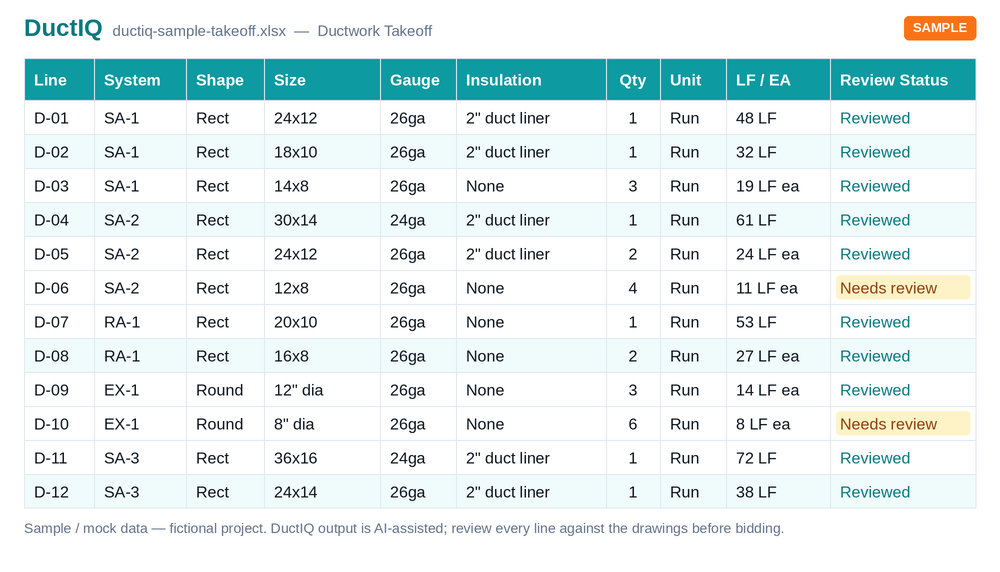
The deliverable: Excel that lands in any estimate
DuctIQ exports the full duct takeoff — runs by system, size, and gauge with linear feet, typed fittings, equipment and air devices, sheet-metal weights — as structured Excel or CSV in one click. It drops into a pricing workbook or a platform import without re-keying, so adding DuctIQ beside STACK costs nothing in lock-in either direction.
The sample below comes from the real export pipeline; open the columns before you create an account:
Download the sample takeoff (Excel)Download the CSV versionHow the export is structured
Settle it on one real bid
Take a mechanical set you have already estimated in STACK. Upload the same PDF to DuctIQ — the first takeoff is free — and compare duct linear feet by system, fitting counts by type, gauge handling, and pounds against your drawn numbers, along with the estimator-minutes each path consumed. Keep whichever process your bids trust.
Start your free takeoffSee pricing & plans
Run your first takeoff free
Upload a mechanical PDF and get a reviewable ductwork, fittings, and equipment takeoff you can export to Excel. No credit card to try your first drawing.
Start your free takeoff Download a sample takeoff See pricingNew to AI takeoff and want a hand? Send us your first drawing and we'll help you review the output, or book a 1:1 walkthrough.
Related HVAC takeoff guides
Frequently asked questions
Is DuctIQ a replacement for STACK?
For the HVAC duct takeoff, yes — DuctIQ automates the measuring STACK's tools help you draw. For plan management, multi-trade estimating, and team collaboration, no: STACK is a platform, DuctIQ is a duct takeoff engine. Because DuctIQ exports standard Excel/CSV, many shops sensibly run both — STACK as home base, DuctIQ for the duct scope.
Does STACK do automated HVAC takeoff?
STACK's takeoff tools centre on the estimator drawing measurements, with releases like Snap to Plans making that faster and more precise. Since September 2026, STACK IQ also lets users ask for takeoffs in plain language. Ask STACK to show it on your own mechanical set and look specifically for duct output: sizes, systems, fittings and gauge, each traceable to the sheet.
What is STACK IQ?
STACK IQ is STACK's conversational AI capability, launched September 1, 2026. STACK says users can build takeoffs, audit estimates for missing items, generate proposals and set up projects from an email by describing what they need in plain language, with STACK connected to AI models including Claude and ChatGPT. Check stackct.com for its current scope.
How is DuctIQ's output different from STACK's?
Units. A drawn takeoff produces lengths, areas, and counts you interpreted while drawing. DuctIQ returns mechanical units directly: duct linear feet by system and size, typed fitting counts, equipment by tag, SMACNA-aware gauge per run, and pounds by gauge — the shape a sheet metal bid prices in.
Does DuctIQ handle SMACNA gauge and duct weight?
Yes — gauge is resolved per run from the project spec when stated and from SMACNA low-pressure minimums when not, labelled as a minimum so it is never mistaken for a verified value. Pounds come from published galvanized lb/ft² tables by gauge, the same ones behind DuctIQ's free duct weight calculator.
Can I try DuctIQ without leaving STACK?
Yes — there is nothing to migrate. Upload one mechanical PDF in the browser, review the takeoff line by line, and export Excel/CSV into whatever prices your bid. The first takeoff is free, and the sample export on this page shows the deliverable before you even sign up.
What does DuctIQ cost compared to STACK?
DuctIQ's pricing is published: monthly plans from $29.99 CAD with per-sheet credits shown before each job runs, cancel anytime. STACK's pricing varies by plan and seat count — get current figures from STACK and compare against a subscription scoped to just the duct takeoff.